Backrooms
The Backrooms film explained in one sentence: it is the 2025 Blumhouse horror film in which a teenager falls through the floor of a corporate office and wakes up in the Backrooms, the infinite maze of empty, damp yellow offices from the internet, and the final shot reveals he is trapped in a loop, since he wakes at the exact same desk where he fell.
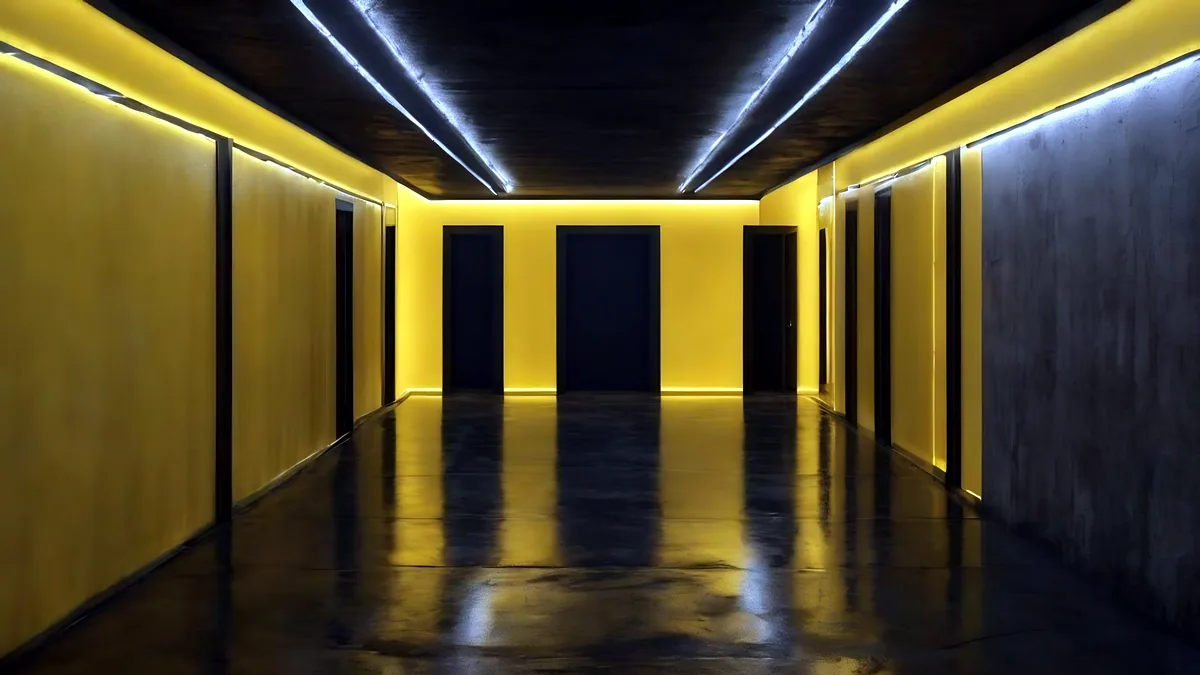
The film took the festival circuit route rather than a red-carpet unveiling at the Cannes Film Festival, screening at genre Film Festivals before it reached UK cinemas in 2025. The Backrooms concept is also a structural cousin to Memento, Christopher Nolan's 2002 thriller: both tell stories by rearranging the order in which the audience learns them. That is the craft of film, end to end, at work on an idea that began as a 50 word creepypasta.
What the Backrooms actually is
The Backrooms is a fictional horror setting, and the film explains it through its opening scenes: a man falls through the floor of a grey office building, lands on a carpeted floor, and finds himself in an endless grid of yellow rooms hummed over by fluorescent lights. The setting is the internet's, not the studio's. It started in 2019 as a post on 4chan: 14 words of text, 1 photograph, and the sentence about "noclipping" out of reality that gave the concept its name. By 2022 the format had spread to YouTube, where searchers could find thousands of video essays and first-person walkthroughs, and the lore grew into a full mythology with named levels, entities and factions.
The film keeps the core and adds rules of its own:
- Entry happens by noclip: a glitch in reality, shown as the protagonist falling through the office floor
- Wet carpet, yellow walls and the hum of fluorescent lights mark the area known as Level 0
- The space is infinite but not random: corridors repeat, rooms loop, and the layout rewards pattern-spotting
- Staying calm matters more than running, because the film's entities hunt by sound
Where the film sits in the Backrooms timeline
The film sits in the Backrooms timeline as the first live-action feature to use the setting, and it did so without a licence from any single author, because the concept has no owner. That is unusual, and it explains both the film's freedom and its controversy. The 2019 post belongs to its original writer, but the mythos that followed was built by thousands of contributors: level descriptions, entity guides, faction histories and video series, all in the public domain of internet folklore. The film's producers, working with Blumhouse, treated the setting the way a director treats a public-domain ghost story: the bones are shared, the house is theirs to furnish. Critics who felt the film ignored the deeper lore pointed out that the film's rules differ from the community's; defenders answered that a 90 minute film cannot carry an entire wiki, so it borrowed the entry point, the yellow rooms and the sense of scale, and invented the rest around its own character.
The levels: what they are and how the film uses them
The levels are the numbered rooms of the Backrooms, and the film compresses the community's hundreds into the handful its story needs. In the full internet lore, each level is a self-contained zone with its own geometry, hazards and survivability rating, and the 2019 post's single yellow room became Level 0. The film's geography works like this:
| Place | What it is | Function in the film |
|---|---|---|
| Level 0 | The original yellow offices: wet carpet, flickering fluorescent lights, endless corridors | The entry point and the default trap |
| Deeper levels | Altered zones the film invents for its story, following the community convention of numbered, self-contained spaces | Escalating hazards that test the protagonist's rules of survival |
| Safe rooms and exits | Rare pockets of shelter that the lore reserves for the patient | The few moments of rest before the loop closes |
The numbering convention matters: in the lore, a level's number is its address, and searchers navigate the mythos by level, the same way film fans navigate a franchise by entry point. The film borrows that address system so viewers who already know the levels can feel at home in the maze, while newcomers get a legible map of 3 zones instead of a 300 page wiki.
The ending, and why it is a loop
The ending is a loop, and the film makes the point in its final 3 shots. The protagonist believes he has found the way out, crosses what looks like a boundary, and then wakes at a desk: the same grey office, the same hum of air conditioning, the same fall through the floor. The film does not explain the mechanism, and that silence is the design. The Backrooms lore has always included the idea that the space folds time as readily as it folds space, and the film takes that one idea and turns it into its whole argument: the maze is not a place you escape, it is a pattern you repeat. A second viewing confirms what a first one hints, because the loop is seeded in the opening shot itself. That structure is the film's closest kin to Memento's reversed timeline, except here the repetition is the trap rather than the puzzle.
Three readings of the ending circulate among viewers:
- Literal loop: the protagonist will fall again, and the film's last frame is the first frame of the next cycle
- Trapped mind: the office he keeps returning to is the backroom of his own head, and the maze is his refusal to leave
- Open door: the loop closes for him but not for everyone, which is why a sequel can enter the same space without repeating the same story
Where to go next
Where to go next depends on what you want from the Backrooms after the film. For the lore, the community's level index is the canonical starting point, and the 2019 post is the shortest possible introduction to the whole setting. For the film's making, the behind-the-scenes material on the production's practical sets is where the craft of the maze, end to end, shows its work: built corridors, painted floors, and fluorescent rigs that give the yellow rooms their 60 hertz hum. And for the wider question of how an idea with no owner became a 90 minute film, the story of the 2019 post, the 2022 wave of YouTube video essays, and the 2025 release is itself the genre's case study: the Backrooms belongs to the internet, and the film is its first feature-length echo.